
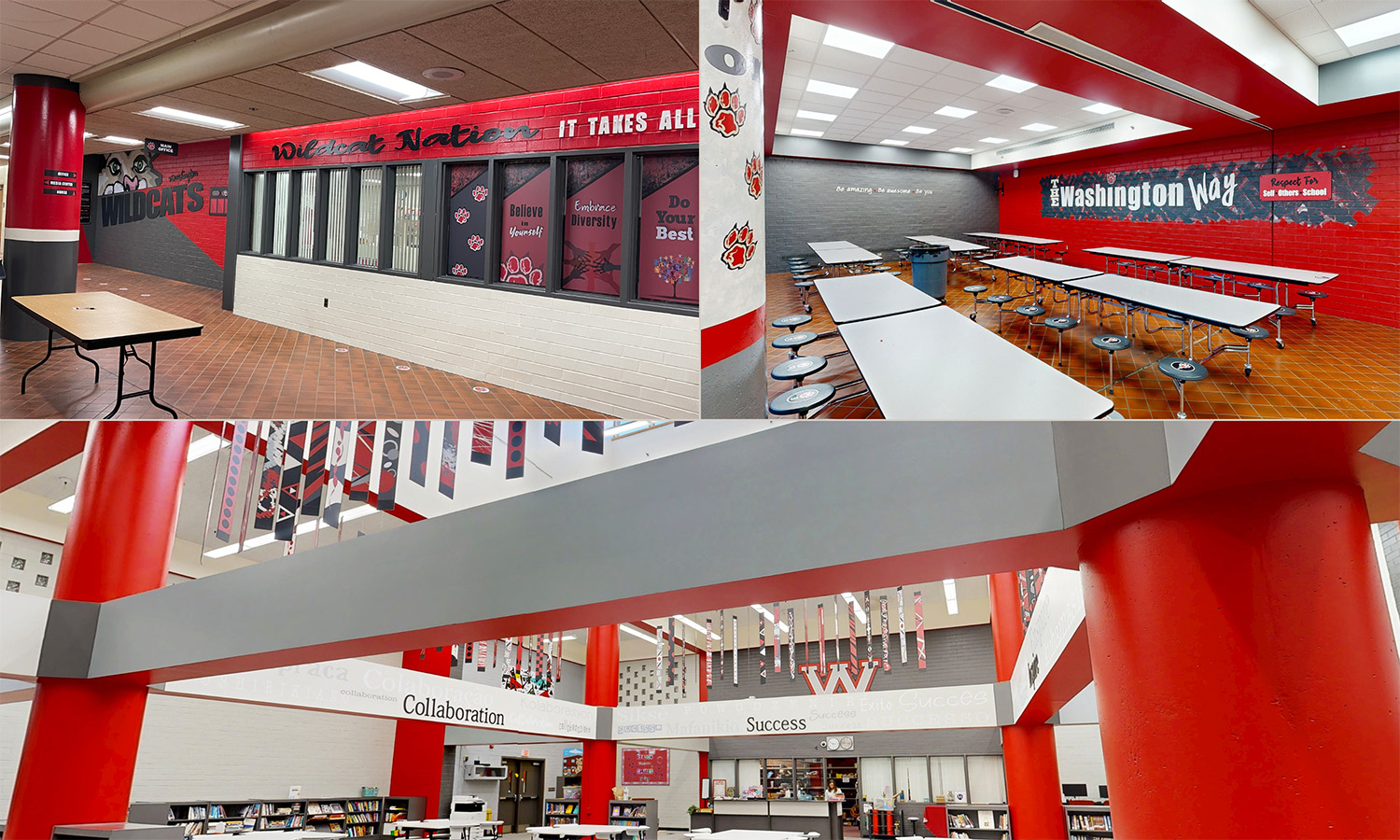
How to make a district feel connected without making every campus identical.
A superintendent is not just managing buildings. You are managing a district identity, whether you set out to or not. Designing for schools at the district level means deciding what that shared identity is on purpose, instead of letting it grow by accident. And in most districts, it grew by accident. One campus has a beautiful renovated entrance. Another still runs mascot art from fifteen years ago. A third has cafeteria signs nobody remembers ordering. Each decision made sense at the time. Stacked together, they make the district feel uneven.
The fix is trading that accidental growth for a system. Not a rigid one that flattens every campus into the same look, but a framework that lets each school feel like itself while clearly belonging to the same family.
Designing for schools is not like designing for a business
Designing for schools is different from commercial design because school spaces must survive heavy daily use, work across a wide range of ages, stay safe and easy to maintain, help people find their way, and serve students, staff, and families all at once. Durability and clarity matter more than anything fashionable.
A restaurant or an office can chase a trend. Schools cannot. A design that photographs beautifully but cannot survive a school year is a failure no matter how good the rendering looked.
Start with the district identity
Before any single campus gets touched, the district level has to be settled. This is the foundation everything else hangs on:
- District logo and approved usage
- Official colors and how they pair
- Typography
- Mission and values
- Tone of voice
- A consistent photography or illustration style
- Basic signage rules
Then give each campus room to be itself
A shared system does not flatten your schools into copies of each other. This is the fear that stops a lot of districts, and it is the wrong one. Each campus keeps its own mascot, colors, traditions, and student culture. What the system adds is a thread that ties them together, so the differences read as part of one district instead of a dozen unrelated buildings. Done right, a visitor can tell they are in your district the moment they walk in, and know exactly which school they are standing in a second later.
Build a visual hierarchy across campuses
The thing that prevents visual chaos is a clear order of operations. When everyone knows what sits above what, decisions get easier and the district stops contradicting itself:
- District identity at the top
- School identity
- Mascot identity
- Department or program identity
- Temporary campaigns and announcements at the bottom
Design the spaces students use most
Not every wall deserves equal investment. A handful of spaces carry most of the weight across every campus, and that is where the budget should go:
- Cafeterias need menu signage, clear line flow, and visible school pride.
- Entrances set the first impression and tell visitors they are in the right place.
- Hallways handle navigation and carry everyday culture.
- Gyms hold athletics and legacy.
- Commons areas are about belonging.
Spend where students actually live.
Why consistency saves money over time
A visual system is not only about looks. It is a budget tool. Once the rules exist, every future project gets faster and cheaper, because nobody is reinventing the colors, fonts, and layout from scratch each time. The next mural, the next set of menu boards, the next mascot refresh all start from an established place instead of a blank page. One-off decisions are where districts quietly bleed time and money.
How to phase a district-wide project
You do not have to do everything at once, and you should not try. A phased approach keeps it manageable and lets you prove the value before scaling:
- Phase 1: Visual audit of what exists now
- Phase 2: Establish district standards
- Phase 3: Pilot one campus or one cafeteria
- Phase 4: Roll out to priority spaces
- Phase 5: Complete the remaining campuses
- Phase 6: Maintenance and updates
What to ask before hiring a design partner
This is a specialty, not a general design job. Before you hire anyone, get clear answers:
- Do they actually understand K-12 environments?
- Can they design, manufacture, and install, or do they hand off the hard parts?
- Do they understand cafeterias and food service spaces specifically?
- Can they adapt one system across multiple campuses?
- Do they create custom mascot and wall graphics, not just templates?
A district should feel connected, not copied and pasted
Designing for schools at the district level is a balancing act. Every campus should feel like part of the same district while still honoring its own mascot, history, and student culture. Hitting that balance is the entire job, and it is hard to do without a plan.
Start with the audit and the standards, prove the system on one campus, then let it earn its way across the rest. A district that feels connected did not get there by accident. Someone decided it should, and built the framework to make it stick.
FREQUENTLY ASKED QUESTIONS
What does designing for schools mean at the district level?
Designing for schools at the district level means building one visual system that ties every campus together while letting each keep its own mascot, colors, and traditions. Instead of letting identity grow by accident, the district decides on shared standards for logo, color, type, and signage, then applies them campus by campus.
How is designing for schools different from business design?
School design has to survive heavy daily use, work across many ages, stay safe and easy to maintain, aid wayfinding, and serve students, staff, and families at once. Durability and clarity matter more than trends. A look that photographs well but cannot last a school year fails, no matter how good the rendering.
How can a district stay consistent without making campuses identical?
Set the district identity first, then give each campus room within it. Shared standards for logo, color, type, and signage create a common thread, while each school keeps its own mascot, colors, and culture. The goal is that a visitor knows they are in your district immediately, and which school a second later.
How should a district phase a campus design project?
Work in phases rather than all at once. Start with a visual audit of what exists, set district standards, then pilot one campus or cafeteria to prove the value. From there, roll out to priority spaces, complete the remaining campuses, and plan for ongoing maintenance and updates.
What should a superintendent look for in a school design partner?
Look for a partner who understands K-12 environments specifically, not general design. Ask whether they can design, manufacture, and install rather than handing off the hard parts, whether they know cafeterias and food service spaces, whether they can adapt one system across many campuses, and whether they create custom mascot and wall graphics rather than templates.