
Your website is for visitors. Your walls are for students.
Most districts pour real time and budget into the website, the newsletter, and social media. That is the right instinct. Those are the front doors for parents and the wider community. But there is a gap in the thinking. Parents might check the website a few times a month. Students walk past the same walls every single day. The building they move through is the version of your brand they actually live inside.
Public school branding is not a logo file sitting on a server somewhere. It is the feeling a student gets walking through the front door, the pride they feel under the gym mascot, and whether the cafeteria looks like a room built for them or a room where lunch happens to take place.
What is public school branding?
Public school branding is the identity a building communicates: your colors, your mascot and how it gets used, your mission and values, your signage, and your wall graphics. A logo is part of it, but a small part. It is everything that tells a student what kind of place they belong to before a single word is spoken. Most schools already have the raw ingredients. What they lack is a system that puts those ingredients to work in the spaces students use.
Where public school branding earns its keep
Think about how a student moves through a day. They arrive in the morning, walk the halls between classes, line up for lunch, sit in the cafeteria, gather in the commons, and pack into the gym for events. Every one of those spaces is a chance to reinforce who you are, or a chance you let slip past. A website earns a handful of visits a month. A single hallway wall earns hundreds of impressions a year from every student who walks it. The physical building is the highest-frequency communication channel a school will ever own, and most of it is running on default.
That is also where the difference between decoration and identity shows up. Decoration fills space. Identity gives space meaning. A nice mural with no connection to your school is decoration. It looks fine and does no work. A branded wall that pulls in your mascot, your colors, your history, and your expectations works every day it hangs there. Same wall, same cost, completely different return.
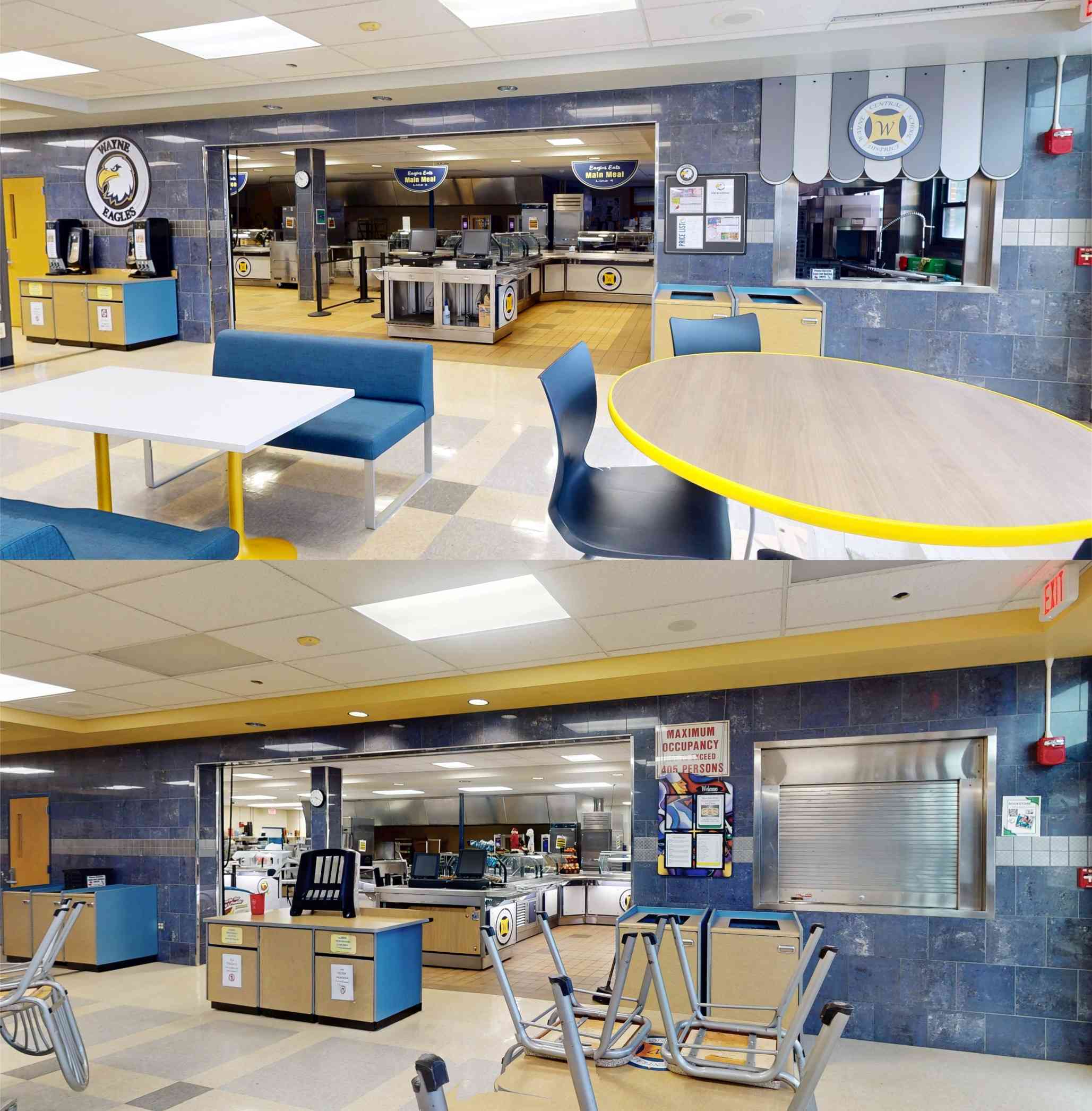
The cafeteria is the wall most districts forget
One room deserves singling out. The cafeteria is among the few spaces nearly every student uses daily, and it is almost always the last to get any design attention. It can feel institutional and forgotten, or it can feel welcoming, organized, and clearly built for students. For a room that every student passes through, that is a surprising amount of identity to leave on the table.
A branding walk-through you can do this week
You do not need an outside firm to find the gaps. Walk your building the way a first-time visitor would, and ask yourself a short list of questions:
- Does the entrance feel like our school, or like any school?
- Can a stranger spot our mascot and colors within a few seconds?
- Do the cafeteria walls support the student experience, or ignore it?
- Are our values actually visible where students gather?
- Do our signs look like they belong to the same system?
- Does the building feel current, or patched together over the years?
If you flinch at more than a couple of those, the building is already telling a story you did not write on purpose.
Branding is daily culture, not vanity
The mistake is treating school branding as a marketing line item. It is closer to culture. A polished website is worth having, but it is not where a school's identity gets built. That happens in the building, in the spaces students pass through without thinking, day after day. When the environment reflects who you are, students absorb it, and so does everyone who walks through the door. The walls are saying something already. The only real question is whether you chose the message.
--- FREQUENTLY ASKED QUESTIONS ---
What is public school branding?
Public school branding is the identity a building communicates through its colors, mascot, mission and values, signage, and wall graphics. A logo is only a small part. It is the feeling a space gives a student about what kind of place they belong to, built into the rooms they use every day rather than a file on a server.
Why does public school branding matter?
It matters because the building is the highest-frequency channel a school owns. Parents may visit the website a few times a month, but students walk the same halls and cafeteria every day. Those spaces shape culture and belonging, so branding done well reinforces identity hundreds of times a year per student.
Is school branding just a logo?
No. A logo is a small part of school branding. The fuller system includes your colors, how the mascot is used, your mission and values, signage, wall graphics, and the overall sense of identity a space gives off. Most schools have the raw ingredients but lack a system that puts them to work.
What is the difference between decoration and school branding?
Decoration fills space; branding gives space meaning. A nice mural with no connection to the school looks fine and does no work. A branded wall that pulls in the mascot, colors, history, and expectations works every day it hangs. Same wall and same cost, but a completely different return.
How do you audit your school's branding?
Walk the building as a first-time visitor and ask whether the entrance feels like your school, whether a stranger can spot the mascot and colors fast, whether the cafeteria supports the student experience, whether values are visible, whether signage looks like one system, and whether the space feels current.